

Red River Rivalry Traditions
The Red River Rivalry stands as one of the most storied and electric traditions in college football, pitting the Texas Longhorns against the Oklahoma Sooners in a clash steeped in history, state pride, and pure pageantry. Played every October at the Cotton Bowl in Dallas during the State Fair of Texas, this matchup has been a cultural staple for well over a century dating back to their first meeting in 1900, with the Dallas tradition kicking in during the late 1920s and settling into the Cotton Bowl since 1932.
The Golden Hat Trophy
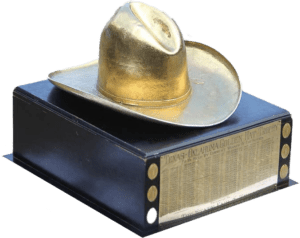
The star of the show is the Golden Hat—a 10-gallon cowboy hat, originally bronze when introduced in 1941 by the State Fair of Texas and UT students, later gold-plated for that signature shine. It sits atop a wooden base etched with the history of the series and gets awarded right on the field to the winner. The winning school hangs onto it until the next year’s game, and those postgame photos with players donning (or hoisting) the hat have become legendary: think Colt McCoy celebrating after Texas’s upset of No. 1 Oklahoma in 2009, or the Longhorns reveling in their 49-0 blowout shutout in 2022.
But the Golden Hat isn’t the only hardware on the line. The winner also claims the Red River Rivalry Trophy (introduced in 2003, designed by student leaders from both schools, and swapped between the fan bases/student bodies each year) and the Governors’ Trophy (or Governor’s Cup, traded between the Texas and Oklahoma governors to highlight the interstate bragging rights that go way beyond football).
The Setting: Cotton Bowl Stadium & the State Fair of Texas
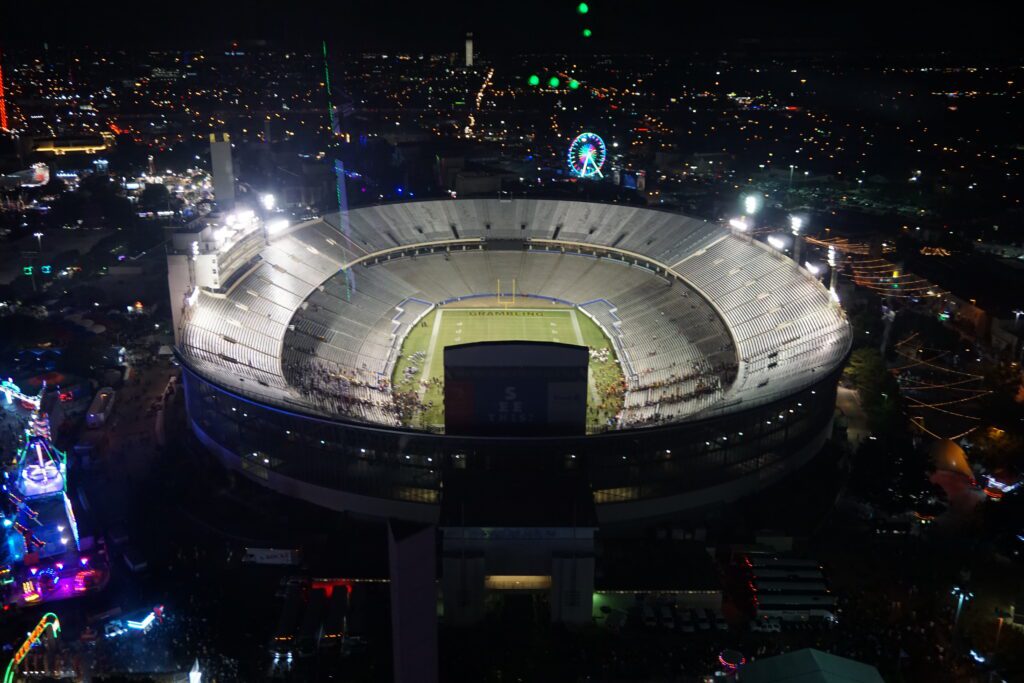
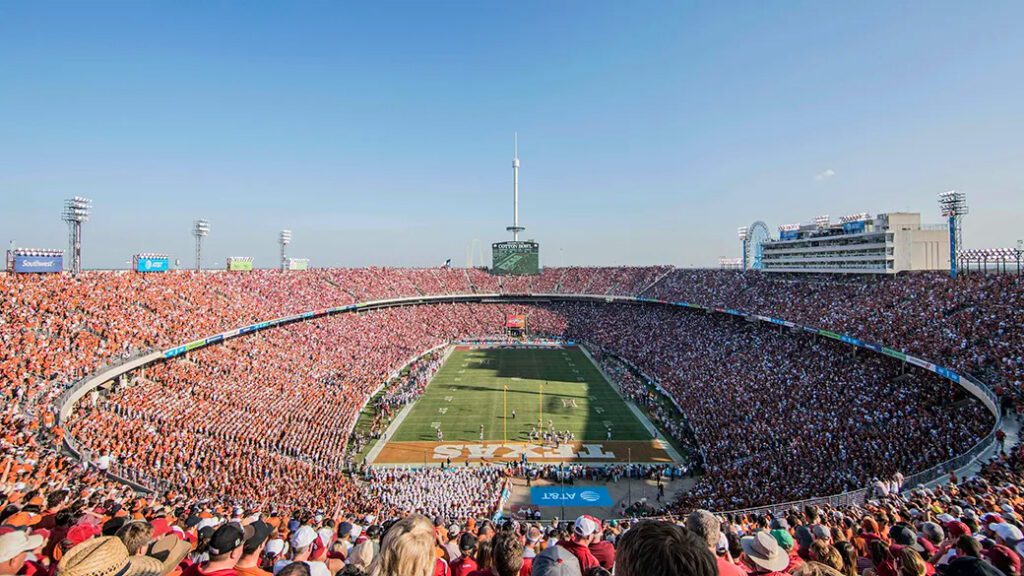
What sets this rivalry apart is its one-of-a-kind venue and vibe. The game unfolds at the historic Cotton Bowl Stadium in Fair Park, a neutral ground where the stadium gets split right down the middle: burnt orange flooding the south stands for Texas fans, crimson and cream taking the north for Oklahoma. Capacity hovers around 92,000 (often listed at 92,100 for these games), and the 50/50 ticket split means no true home advantage, just wall-to-wall energy that flips back and forth with every big play.
Timing it with the State Fair of Texas turns game day into a massive festival. Fans roll in early to hit the midway, chow down on Fletcher’s Original Corny Dogs (invented right there in 1942 and still the fair’s signature bite), and take in sights like the 55-foot talking cowboy Big Tex welcoming everyone at the entrance. The whole scene pulls well over 100,000 (sometimes closer to 200,000 across the fairgrounds) into the area, blending fried fair food, carnival rides, and high-stakes football in a way no other rivalry can touch.
The 50/50 Stadium Split
That even ticket division creates one of the most visually stunning atmospheres in sports. The Cotton Bowl is divided precisely along the 50-yard line, splitting the stands into two distinct halves: the south side (typically sections 1-26 or lower-level equivalents) goes to Texas fans in burnt orange, while the north side (sections 101-126 or similar) fills with Oklahoma’s crimson and cream. This north-south orientation means the color divide runs end zone to end zone, creating a perfect visual seam right through the heart of the stadium.
The setup has some historical quirks too. Oklahoma fans have traditionally occupied the south side around the tunnel entrance (where both teams enter/exit the field via Gates G, J, K, L, M), giving them proximity to the players’ path. Since 2007, there’s been an option for the designated “home” team to alternate ends and claim the tunnel-adjacent seats, but Texas has generally declined to switch when it’s their turn, sticking with the longstanding pattern. Either way, the 50/50 split ensures neither side gets outnumbered—fans from both schools sit shoulder-to-shoulder in shared sections at times (like parts of section 6, where rows might be divided between the two), and the crowd noise surges dramatically from one half to the other with every momentum shift.
It’s pure chaos in the best way: no quiet pockets, no lopsided cheers, just constant tension and energy that keeps the place rocking from opening kickoff to the final gun. Aerial shots or TV pans during the game show that iconic split better than anything—half the bowl one color, half the other, with the 50-yard line acting like a literal dividing line in the rivalry.
Fan Traditions & Game Day Atmosphere
Texas fans pack the south end with Hook ’em Horns signs flashing everywhere, while the Longhorn Band cranks out “The Eyes of Texas” at big moments. The sound of tens of thousands belting it out together is spine-tingling.
Oklahoma answers right back with the Pride of Oklahoma marching band blasting “Boomer Sooner” relentlessly. And after every Sooners touchdown, the Sooner Schooner rolls out: a scaled-down covered wagon pulled by two white ponies (Boomer and Sooner) galloping across the field. The tradition started in 1964 and became the official mascot setup in 1980, adding that classic Wild West flair.
The Name: From Shootout to Rivalry
The rivalry has carried several official names over the years, evolving with sponsorships, cultural sensitivities, and marketing shifts. While fans still casually use “Red River Shootout,” “Red River Rivalry,” and “Red River Showdown” interchangeably, the branded title has changed multiple times making it one of the more fluid nicknames in college football.
Here’s the complete timeline of official names:
| Years | Official Name | Sponsor | Key Notes | Series Record in Era (Texas lead) |
|---|---|---|---|---|
| 1900–2004 | Red River Shootout | None | Original name; tied to the Red River border and Wild West imagery. Still the most nostalgic term for longtime fans. | 55-39-5 |
| 2005 | SBC Red River Rivalry | SBC Communications | Changed for the 100th meeting to drop “Shootout” (avoiding gun-violence connotations) and add first corporate sponsor. | Texas 1-0 |
| 2006–2013 | AT&T Red River Rivalry | AT&T | Continued after SBC merged with AT&T; kept the “Rivalry” focus on competition over violence. | Texas 4-4 |
| 2014–2022 | AT&T Red River Showdown | AT&T | Marketing rebrand emphasizing a “showdown” feel; never fully caught on with fans. | Oklahoma 6-3 |
| 2023–present | Allstate Red River Rivalry | Allstate | Returned to the traditional “Rivalry” name under new sponsor; athletic directors called it a revival of the game’s iconic identity. | Ongoing (Texas leads overall 65-51-5 as of 2025) |
The 2005 shift was the most debated: officials wanted to distance the game from anything evoking gun violence, especially amid growing national conversations. The 2014 “Showdown” change was short-lived and mostly sponsor-driven, while the 2023 return to “Rivalry” felt like a nod to tradition as the teams entered the SEC era. Today, all three names coexist in broadcasts, fan chants, and searches – proof of how deeply embedded the game is in Texas-Oklahoma culture.
Buy Tickets
This one’s always a hot ticket and often one of the toughest in college football. Secondary market prices swing hard based on rankings, conference stakes, and how close to kickoff you wait. Grab them early if you’re planning to experience it in person.
This rivalry isn’t just a game; it’s a full-on Texas-Oklahoma showdown wrapped in fairgrounds fun, iconic trophies, and traditions that keep fans coming back year after year. Whether you’re burnt orange or crimson through and through, there’s nothing else quite like it.